
How Johnson County Property Records Connect
Start in the PVA qPublic search. It supports lookups by owner, location address, parcel number, and legal description. Take the parcel number and owner of record from that result into the sheriff tax system and the clerk eCCLIX index. Keep the date and citation for each Johnson County property records source you use.
Official records show an assessed owner, a value, a bill status, and recorded instruments. They do not guarantee title, fix a surveyed line, or set a current sale price. Confirm anything important with the office holding the original record.
- Search qPublic by address, owner, parcel, or legal text.
- Copy the parcel, assessment year, and roll owner.
- Find the latest deed in eCCLIX.
- Check the sheriff bill and payment status.
- Use the counter, KORA request, library, or KDLA when web coverage ends.
The Paintsville Offices Behind Johnson County Records
Three Paintsville offices divide the work. The county clerk records legal instruments, the PVA prepares the assessment roll, and the sheriff collects property tax. All post weekday hours. Each controls a different record.
eCCLIX's 1966 Index and 2004 Images
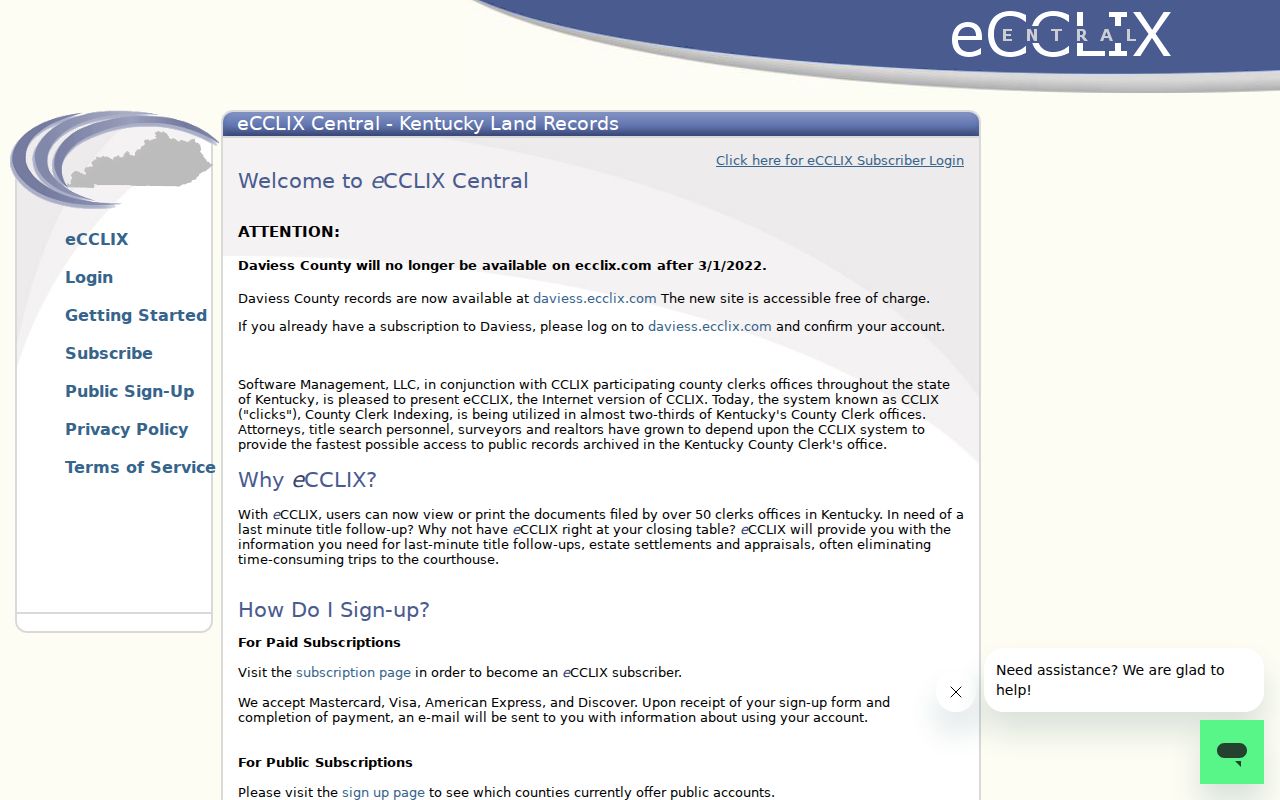
Deed and mortgage indexing in Johnson County reaches back to 1966. Online instrument images, though, mostly begin in January 2004. eCCLIX access requires an account and may carry fees. At the counter, the clerk reports, public indexes and documents are free to inspect. The official eCCLIX system displays the county's land records.
A 1970s index hit with no online image still matters.
The January 1 Johnson County Owner
Kentucky fixes January 1 as the assessment date. Everything on the tax roll follows it. So a parcel sold later in the year can still show the former owner of record on the current bill, even though the newly recorded deed names the grantee. Before assuming two Johnson County property records conflict, compare the assessment year against the deed recording date.
Johnson GIS Comes With an Inspection Gap
Johnson County publishes no working parcel viewer. No identify, buffer, or adjacent-parcel tool appears on the PVA GIS page. Kentucky's open GIS portal supports statewide map discovery. Yet no complete Johnson County parcel layer is established through it. Rely on plats, deed records, PVA files, and state maps. Treat every GIS line as reference rather than survey evidence.
Types of Johnson County Property Records
One tract can hide under five labels: street location, parcel account, party name, book-and-page citation, or old descriptive calls.
| Record Type | What It Documents | Kept By | Access |
|---|---|---|---|
| Deeds | Conveyances and descriptions | Clerk | eCCLIX, counter, request |
| Mortgages and liens | Encumbrances and releases | Clerk | Land-record channels |
| Assessment | January 1 owner, value, exemptions | PVA | qPublic and office |
| Tax bills | Account, amount, status | Sheriff | Portal and office |
| Plats and surveys | Lots and boundary calls | Clerk/KDLA | Recorded filing and reels |
Turn to Johnson County deed records for conveyances and Johnson County property tax records for values, exemptions, bills, and appeals.
Johnson County Records Before the Web
The KDLA inventory catalogs deeds from 1843 to 1987, surveys from 1843 to 1935, wills from 1844 to 2003, and tax books from 1844 to 1892. Tax microfilm from as early as 1793 is available in the library's Kentucky Room. Older descriptions lean on creeks, branches, ridges, roads, acreage, or adjoining owners rather than a parcel number.
DocAlert Watches Johnson Deeds and Mortgages
The clerk offers free Johnson County DocAlert. Subscribe a personal or business name, and the service emails you when a deed or mortgage is recorded under it. It is notification only, not a title lock. Pull any unfamiliar filing and call the clerk on independently verified details.
When a Johnson County Portal Stops
When a portal stops, the Kentucky Open Records Act still works. The clerk takes written requests by hand, mail, fax, or email. The law allows five working days to produce records. It also lets the office explain a delay or denial under KRS 61.878. Describe the party or parcel narrowly, name the record type, and give a date span. Noncommercial paper copies run 50 cents each. Postage and advance payment may apply.
Search Johnson County by Address, Owner, or Parcel
An address is the strongest starting point when you know the physical place. In the PVA application, begin with the house number and base road name. Turn to the exact-match control only after a broader query returns too much. County guidance for the sheriff's tax portal says a Property Location query should drop the street direction. It should also drop the street type. The situs line identifies the property location. The mailing line shows where owner correspondence goes. The two are not interchangeable.
An owner search helps find assessment entries. It can also surface recorded instruments tied to a person, estate, trust, or business. Keep the exact spelling from the official result, then test initials, spacing, and entity variants. The PVA's exact-name option can narrow a common surname. Meanwhile, eCCLIX's party-and-date method links a name to recorded deeds. A name match alone does not prove every result concerns the same person or tract.
Once known, a parcel or account number is the best cross-office key. Local examples keep prefixes, hyphens, periods, and sometimes an L000 mobile-home suffix. Copy the identifier exactly before trying a normalized version. The sheriff's published example 126-0586-00010 shows why punctuation can matter. A changed number can signal a parcel split, merger, or system formatting difference. It does not mean the property is missing.
| Starting clue | First Johnson source | Carry forward | Typical obstacle |
|---|---|---|---|
| Street address | PVA qPublic | Parcel and roll owner | Direction or street type |
| Owner name | PVA or eCCLIX | Entity spelling and dates | Initials, trusts, estates |
| Parcel number | PVA or sheriff | Exact account format | Punctuation or changed parcel |
| Book/page | County clerk/eCCLIX | Parties and legal description | Image access predates 2004 |
Read a Johnson County Parcel Record Carefully
Read a parcel record as one year's assessment snapshot. The owner name reflects the certified tax roll, not permanent proof of title. The situs address locates the tract. Mailing addresses can differ, pointing to a post-office box or an entity's contact address. The parcel number links the assessment to tax billing and mapping, and the values always belong to the stated roll year.
The PVA site shows no sample card. Available search modes are Owner Name, Location Address, Parcel Number, and Legal Information. A missing field means a phone call. The number is 606-789-2564, and the office sits in Suite 229. Never invent a field from another county's configuration. Ask the office directly.
Owner of record: the person an official record names as owner at its effective date. Situs: where the property physically sits. It is not always the owner's mailing address. Parcel number: the local key matching a tract across county systems. Plat: a recorded drawing of lots and dedications. This is not the same as a current boundary survey.
For a recent sale, carry the roll name into the deed index and find the newest recorded conveyance. For value, check the assessment year and any exemption. Bill status is the sheriff's job. Keeping each source to its own task keeps a portal from proving what it was never built to establish.
Johnson County Tax Bills and Delinquency
The sheriff's online tax-bill portal starts with a Search By selector, a text box, an Account Type choice, and a Paid, Unpaid, or Both filter. Include Inactive Accounts is a toggle. A security check follows. The portal does not state its full year span. Paste the account number from the PVA, or start with a shortened property-location query. Then check owner, parcel, and year.
Payment works online, by mail, or in person at 339 Main Street. Make checks payable to Johnson County Sheriff. Write the bill number on the check. Cards carry a 2.5 percent charge. A paid bill settles that bill only, while the latest recorded deed supplies the conveyance trail.
Delinquent real-property payoffs go through the county clerk. Certificates of delinquency, with assignments and releases, are legal-record filings there. Kentucky's third-party-purchaser process shifts with each active tax season, so a dated sale announcement is never a standing deadline; confirm the current schedule with the county and the Kentucky Department of Revenue.
Assessment, Exemptions, and the Appeal Calendar
Kentucky bases assessments on fair cash value and recognizes the sales, cost, and income approaches. Revaluation happens every year. A physical inspection usually comes around once every four years. Before deciding a value is off, an owner can weigh the PVA description against the land and improvement facts on file. Recent comparable sales help too. Any evidence of condition also belongs in that review.
The listing window for real property runs from January 1 through March 1. The inspection period opens on the first Monday in May. It runs six days a week, Saturdays included, and closes on the third Monday. A conference with the PVA comes before anything else. The appeal deadline lands one working day after the inspection period ends. The local board typically convenes 25 to 35 days after that. From there, a state appeal goes to the Kentucky Board of Tax Appeals. It must arrive within 30 days of the local decision.
Homestead and disability exemptions change the taxable amount. They do not change the recorded ownership or the parcel boundary. The verified exemption amount for 2025-2026 is $49,100. The PVA can confirm eligibility and figures for any other year. Keep assessment, exemption, levy, and bill payment as separate entries in a research file.
Deeds, Liens, Plats, and Releases in Suite 124
The clerk records far more than deeds. The inventory includes mortgages, mechanic's liens, judgment liens, federal and state tax liens, assignments, releases, powers of attorney, easements, plats, contracts, wills, affidavits, and delinquent-tax filings. A tract buyer should study the legal description and every relevant encumbrance, not just the newest grantee name.
The recording-fee schedule, effective January 1, 2020, prices deeds at $50, mortgages at $80, plats and easements at $50, and many releases at $46, plus specified page-overage charges. Those fees cover recording a new instrument only. Inspection, printing, and certification are priced separately. Verify the dated schedule before filing.
When an online result runs thin, bring the party names, an approximate date, the instrument type, and any known book and page. The office is open Monday through Friday. Hours run 8 a.m. to 4 p.m. Precise citations pay off. They separate a similarly named party faster. They also help staff locate an image outside the public online range.
Courts and Estates Can Alter the Land Trail
A Johnson County deed chain rarely travels a straight line. It may pass through probate, a commissioner sale, a sheriff deed, or outright litigation. CourtNet gives you a statewide party and case search. The Judicial Indexes site adds historical searching by county, plaintiff, and defendant. Neither is the complete Johnson court file. The Johnson Circuit Court Clerk holds the official file. Its address is the Johnson Judicial Center, 908 Third Street, Suite 109.
Death-to-title questions need more than a death date. Pair the death evidence with the instrument that actually moved the land. That may be a will, probate order, affidavit of descent, fiduciary instrument, or deed. Kentucky Office of Vital Statistics records can fix the chronology for covered years. A death certificate alone conveys nothing. For earlier estates, check the clerk's will index and the KDLA reels for clues.
Older hand indexes hide useful flags. An H points to an heir, a C to a commissioner transaction, an S to a sheriff deed. Search the grantor and grantee rolls both ways. Follow the legal description, not just the name. Parties change through marriage, an estate, or a business entity. That discipline reconnects chains that look broken in a plain owner-name search.
The statewide Judicial Indexes search accepts a county plus plaintiff or defendant names, including alternate spellings. CourtNet takes party or business details, party type, case type, county, and name. An exact case-number route exists too. Use it when a citation is already known. A result may identify a case worth pulling. The full exhibits, orders, sale reports, and property descriptions stay with the court file itself.
Federal property litigation runs on a different docket. No county-level federal case list exists. A missing land-index entry is not proof that litigation never happened. Flip that caution around, too. A same-name court result does not touch the target parcel on its own. Parties, dates, legal descriptions, and orders must all line up first.
Family property questions benefit from newspapers. Notices and obituaries can supply names and a timeline. The Johnson County Public Library provides access to local newspaper and genealogy resources. But those narratives never replace a deed or probate order. Use them to locate the official filing, then cite the instrument that changes or confirms the land trail. Record your unsuccessful searches as well. A negative result can expose a spelling variant, date gap, unindexed series, or access gate that shapes the next request.
What Johnson County Property Records Establish
One record proves one fact. A roll owner, recorded grantee, assessment, bill status, legal description, plat, lien release, or probate-related filing in the Johnson County property records each holds true only for its own date and purpose.
Lawful use. Use Johnson County property records for legitimate research, due diligence, estate work, and civic transparency. They do not replace a title examination or licensed survey and must never be used to harass anyone.