
Read Johnson County Value Types
A Johnson County parcel can carry several numbers that look alike but answer different questions. Kentucky requires real property to be assessed at fair cash value. That is essentially the price a willing buyer and seller would strike under ordinary conditions. The PVA produces that assessment. A deed may state consideration from an actual transfer. Exemptions can shrink the amount subject to tax without touching the underlying valuation. Keep the label, the year, and the record source beside every figure in a property search.
| Value | What It Is | Where |
|---|---|---|
| Assessed value | PVA valuation placed on the assessment roll for the relevant year | Johnson County PVA |
| Fair cash value | Kentucky’s full-value standard for real-property assessment | PVA roll and state assessment rules |
| Taxable amount | Value remaining for tax treatment after an applicable exemption or classification | Assessment and tax records |
| Last sale consideration | Amount stated or reflected in a recorded transfer, when available | Johnson County Clerk deed record |
Assessed value and sale consideration often differ, and for sound reasons. A deed may reflect an old transfer. It could also be a sale between related parties, or part of a larger deal whose terms the tax roll never shows. The PVA works through mass appraisal across many parcels at once. A sale price, by contrast, belongs to a single event. Kentucky does not tell users to treat the last transfer as the automatic value for later years.
Find Johnson County Assessed Value
The Johnson County qPublic search is the direct assessment route. Its indexed modes include owner name, location address, parcel number, and legal information. The live screen was blocked during research, so exact local card labels, assessment-history fields, and any land-versus-improvement breakout were not verified. Do not assume a field is present until the result page displays it.
When online access fails, contact the Johnson County PVA. The PVA maintains the property-tax assessment roll and explains that real property is assessed as of January 1. That office is the proper source for the certified roll, valuation basis, and questions about a parcel’s classification.
Kentucky Methods Shape Johnson Values
The Kentucky Department of Revenue assessment process lays out three recognized approaches. A sales comparison weighs relevant transfers. A cost approach values land plus improvements, less depreciation. An income approach applies where a property's income-producing capacity matters. The state assessment source notes that the PVA selects the evidence. It reconciles what suits each property.
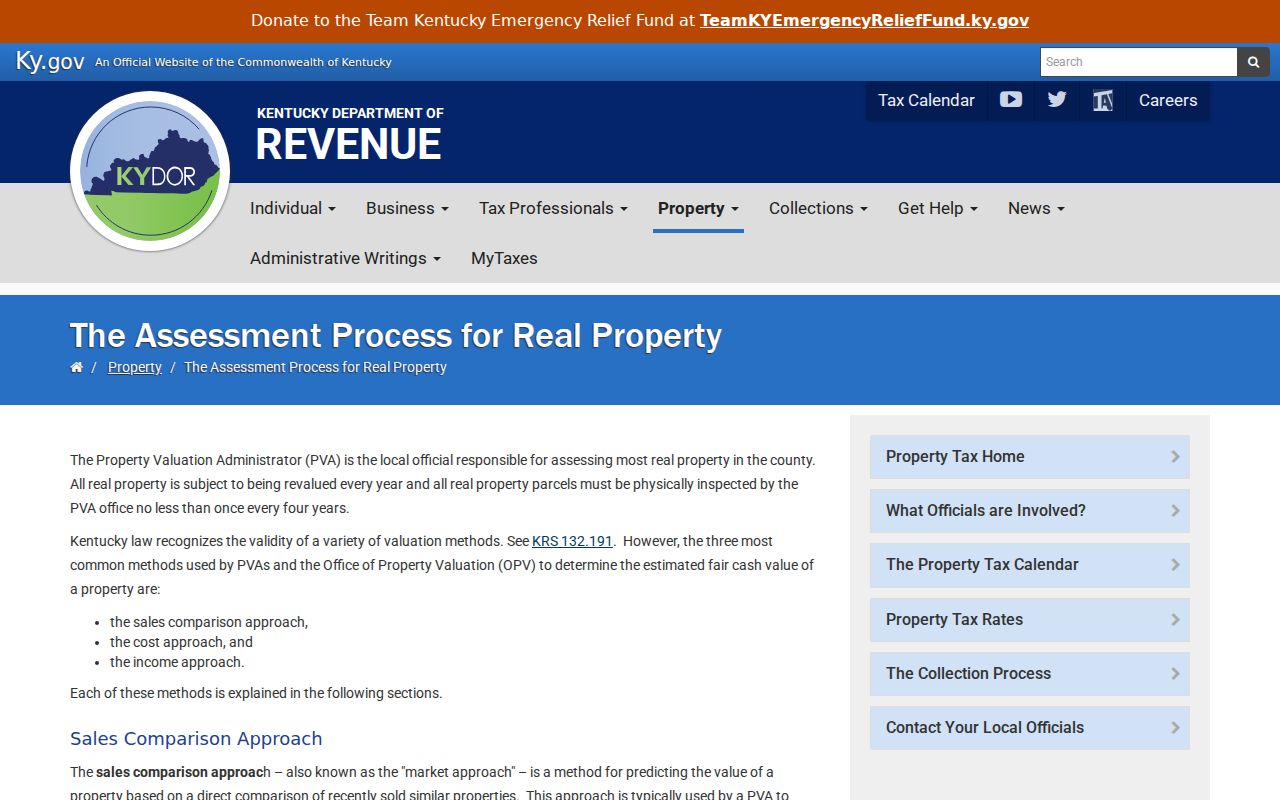
Statewide methods set the frame. The Johnson County PVA remains the custodian for a parcel's assessed value.
No single method promises a future sale price. A house with few recent comparable transfers may lean on cost evidence. An income-producing parcel needs different inputs entirely. The published Johnson County property value is a mass-appraisal conclusion. It is not a private inspection prepared for one deal.
Note: Ask which valuation year and method informed the record. Compare that with a later transfer or listing on its own terms.
Trace a Johnson Property Value
Keep the assessment and transfer records in parallel. Start with the parcel. Note the valuation year. Then compare only records that carry a clear date and label, so the numbers stay honest with each other. If the qPublic screen is unavailable, the tax-bill search can recover the exact account number, though the bill portal is built for payment rather than as the authoritative explanation of valuation.
- Search qPublic by the Johnson County location address. If needed, switch to parcel number or legal information.
- Record the displayed value label and assessment year exactly. Do not relabel an assessed figure as a sale estimate.
- Open the latest transfer through the Johnson County Clerk land-record route and note any consideration the recorded instrument actually shows.
- Compare dates and property interests. A deed for only part of a tract or a non-arm’s-length transfer is not a clean market benchmark.
- Assessed value
- The PVA’s value for the applicable assessment roll.
- Fair cash value
- Kentucky’s statutory assessment standard for the property’s ordinary full value.
- Assessment ratio
- The relationship between an assessed amount and full market value; Kentucky real property is assessed at fair cash value.
- Consideration
- The value exchanged in a conveyance as reflected by the recorded instrument, when stated.
- Reassessment
- A later valuation that updates the roll based on current evidence and review.
Johnson Values Follow Annual Cycles
Kentucky assessment is annual, with property valued as of January 1. The state also describes continuing revaluation work and a four-year physical inspection cycle. Those rules explain why the record has a year and why a new deed does not instantly rewrite every assessment field. The owner tied to a tax roll is likewise the January 1 owner for that roll.
Physical inspection does not mean every parcel receives a full private appraisal each year. It supports the PVA’s broader mass-appraisal process. Improvements, changed use, market evidence, and corrected parcel facts can affect later values. Preserve the year whenever citing a Johnson County property value.
Agricultural Johnson Value Can Differ
Kentucky allows agricultural and horticultural valuation treatment that departs from ordinary fair cash value. A qualifying Johnson County tract may therefore show a tax-related agricultural value. Read that number carefully. It is not the open-market sale price. The classification and eligibility facts matter as much as the figure itself.
Check the PVA record and ask the office how the land is classified. A mixed tract can include improvements or acreage under different treatment. Never apply a value per acre from one classified parcel to a nearby home site. Match the land use first. Match the assessment basis too.
Exemptions Change Johnson Taxable Amounts
A homestead or disability exemption shrinks the taxable amount on a Johnson County parcel. It does not mean the property lost market value. That is the difference between assessed value, taxable value, and the tax bill itself. Blending those numbers leads to wrong conclusions. The PVA and state tax materials govern who qualifies. They also set how large the exemption runs each year.
Questions about a Johnson County tax bill belong with the Johnson County property tax records resource. So do exemption filings and appeal routes. Any valuation lookup should end with knowing what each figure means.
Check Johnson Deed Consideration
The Johnson County clerk indexes deeds and mortgages through the eCCLIX system. Its records reach back to 1966. Most instrument images online start in January 2004. An account is required, and fees may apply. The system will not settle every valuation question on its own.
Start with the index. Find the most recent instrument on the parcel, then open the recorded document itself and read the deed in full. When an image is unavailable online, the clerk's counter holds the public indexes and original instruments, and open-records requests can be delivered in person, mailed, faxed, or emailed. Keep one caution in mind. The consideration stated on a deed proves what a single transfer brought, not what every Johnson County property is worth today.
Paintsville History Needs Separate Proof
Paintsville carries genuine historic depth. A 1936 New Deal project that combined City Hall, the jail, and the fire station appears in a national inventory of that era. The town's recorded past stretches from Paint Lick Station through its later growth. That context can shape how you research a parcel and its surroundings.
It cannot confer landmark status by itself. Nor does it guarantee any price premium. Before attaching a historic claim to a Johnson County parcel, confirm a National Register listing, a local designation, a recorded restriction, or a permit record. Scenic, neighborhood, and civic associations follow the same rule. Helpful context is not a valuation method.
Know Johnson Property Value Limits
An assessment answers one narrow question. It does not set a purchase price, a replacement-cost policy amount, a loan value, or a boundary line. It can also trail behind a fresh sale. The deed records and the January 1 tax-roll clock run on different schedules. Even a recorded sale has limits of its own. Unusual parties, partial interests, or terms far from an ordinary open-market deal can all skew it.
Each professional and record has its job. A licensed appraiser prepares an opinion tied to a stated purpose and effective date. A surveyor handles measured boundary work. The clerk keeps the recorded instruments, and the PVA explains the assessment. Match the question to the right source. Do not push one public number to do everything.
Value is not price. A Johnson County assessed value serves property taxation. It is not a forecast of the sale price and is not a private appraisal.